
From Broke to Woke with a Daily Budget Planner
Where Your Money Actually Goes — and How to Take Back Control
A daily budget planner is one of the most practical tools you can use to stop overspending and start building real financial momentum. Here are the top options to get started right now:
Best daily budgeting tools in 2026:
| Tool | Type | Best For |
|---|---|---|
| AI-powered apps | Mobile application | Automated daily tracking |
| Digital envelope apps | Mobile application | Envelope-style budgeting |
| Spreadsheet templates | Digital file | Custom daily/monthly plans |
| Printable worksheets | Free, simple tracking | |
| Physical planners | Paper planner | Hands-on, screen-free budgeting |
Fewer than 40% of Americans use a budget. Yet research consistently shows that people who do budget save more, stress less, and reach their financial goals faster.
The problem isn’t motivation. It’s that most budgeting systems feel too big, too vague, or too disconnected from daily life.
A monthly spreadsheet tells you where your money went. A daily budget planner tells you where it’s going — before it disappears.
Think of it this way: you make small spending decisions every single day. Coffee, lunch, a quick online order. None of those feel significant in the moment. But they add up fast. Without a daily plan, even a solid income can vanish by the 25th of the month.
That’s exactly the problem a daily budget planner solves.
Why a Daily Budget Planner is Your Secret Financial Weapon
Most of us have tried the “big picture” budget. We sit down at the start of the month, look at our rent, car payment, and insurance, and think we have a handle on things. But then life happens. A daily budget planner acts as your financial GPS, giving you turn-by-turn directions rather than just showing you a map of the destination.
When we use a daily approach, we move away from the “I think I can afford this” mentality toward “I know exactly how much I have for today.” This shift is massive for reducing financial stress. Instead of worrying about a giant lump sum, we focus on a manageable daily number.

To make this work, we often integrate proven strategies like the 50/30/20 Rule. This guideline suggests allocating 50% of your after-tax income to Needs, 30% to Wants, and 20% to Savings and Debt Repayment. When you break that down into a daily limit, you ensure that your “Wants” aren’t eating into your “Savings.”
For those who need more structure, modern AI-powered personal budget apps use advanced technology to help you visualize these limits in real time. Whether you prefer the envelope system (digitally or with cash) or zero-based budgeting (where every dollar has a job), the goal remains the same: total awareness of your cash flow. If you want a broader reference on budgeting approaches, the budget overview on Wikipedia is a useful starting point.
Daily Budget Planner vs. Monthly Spreadsheets
While a monthly spreadsheet is great for high-level planning, it often lacks granular control. If you overspend on day five of the month, a monthly sheet might not alert you until day thirty. A daily budget planner provides immediate feedback. If you spend $50 on a fancy dinner today, you see exactly how that reduces your spending limit for the rest of the week. This flexibility allows you to adjust on the fly, making short-term goals-like saving for a weekend trip-much easier to hit.
The Psychology of Daily Tracking
Budgeting is 20% math and 80% behavior. By tracking daily, we engage in habit formation. It turns the abstract concept of “saving money” into a concrete daily action. This constant contact with our finances builds accountability and naturally improves impulse control. When you know you only have $30 left for the day, that $15 “limited time offer” online suddenly looks a lot less appealing. Real-time data is the ultimate cure for the “spending fog” that leads to debt.
How to Calculate Your Daily Spending Limit Step-by-Step
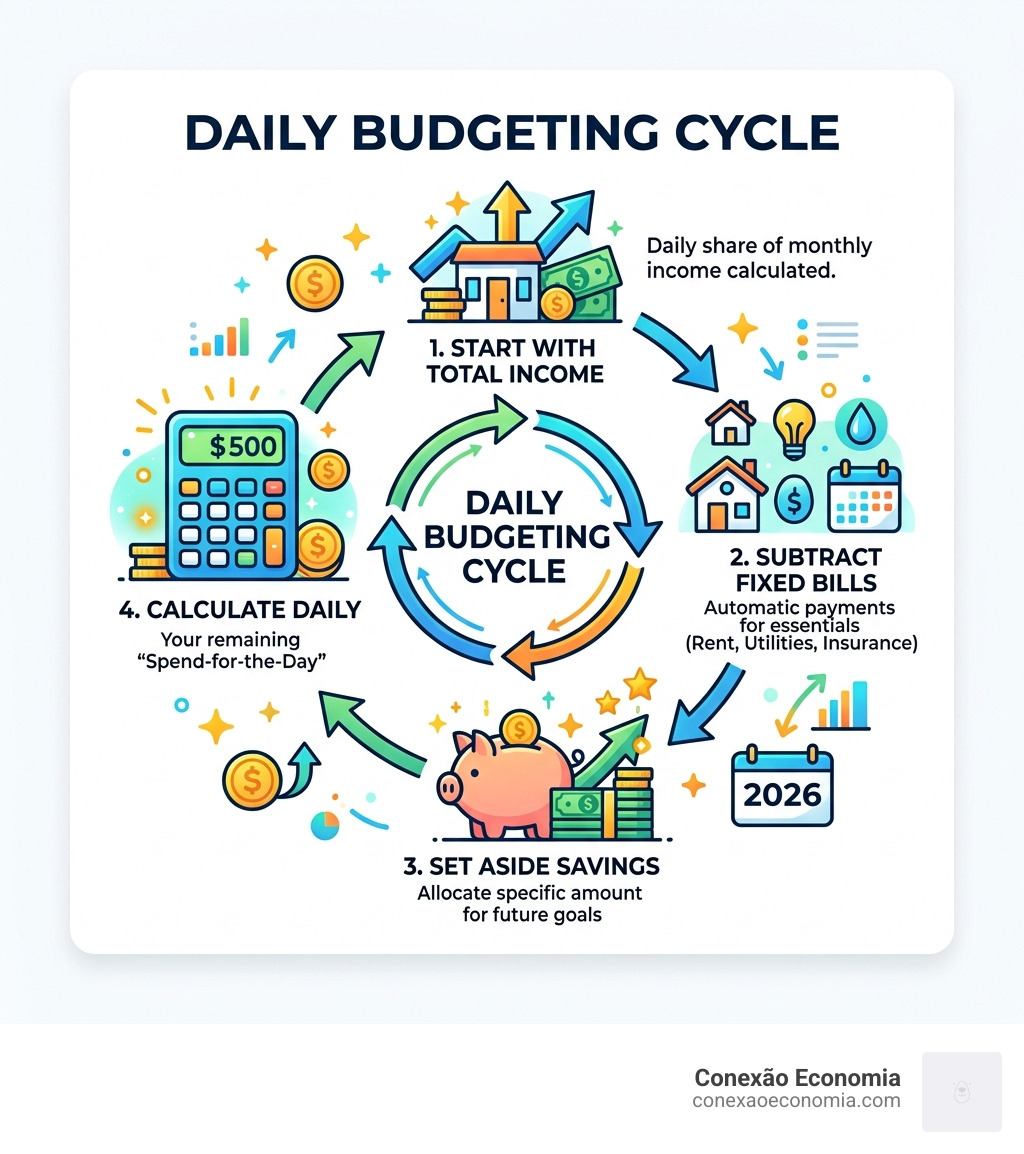
Calculating your daily limit isn’t just about dividing your paycheck by 30. If you do that, you’ll forget about your rent and end up short at the end of the month! We need to follow a specific sequence to ensure all our “must-haves” are covered first.

- Start with Net Income: This is your take-home pay after taxes.
- Subtract Fixed Bills: List everything that doesn’t change—rent, utilities, insurance, and minimum debt payments.
- Deduct Savings Goals: Financial experts recommend aiming for 15-20% of your income for savings. Treat this as a “fixed bill” you pay to your future self.
- Allocate Lifestyle Expenses: These are variable but necessary, like groceries and transportation.
- The “Divide by 30” Rule: Take whatever is left and divide it by 30 (or the number of days until your next payday). This is your flexible daily spending limit.
| Expense Type | Examples | Frequency |
|---|---|---|
| Fixed | Rent, Mortgage, Car Payment, Netflix | Monthly |
| Variable/Lifestyle | Groceries, Gas, Household Supplies | Weekly/Daily |
| Financial Goals | Emergency Fund, Extra Debt Payoff | Monthly |
| Discretionary | Coffee, Dining Out, Hobbies | Daily |
Identifying Your Key Inputs
To get an accurate number for your daily budget planner, you must be honest about your inputs. Use your actual bank statements from the last three months rather than guessing.
- After-tax income: Use your lowest expected amount if you’re a freelancer.
- Housing: Aim to keep this under 30% of your income.
- Debt Repayment: Include credit cards, student loans, and any personal loans.
- Safety Buffer: Always leave a small “buffer” in your account for price variations or forgotten subscriptions.
Determining Your Flexible Daily Budget Planner Limit
Your discretionary spending is where the magic happens. This is the “guilt-free” money you use for fun, dining out, or small treats. A common guideline is to aim for a $10–$15 per person per day food budget, which includes both groceries and occasional dining. If your calculation shows a daily limit of under $5, you are in a “tight budget” zone and may need to look at deficit management—either cutting a fixed bill or finding ways to increase your income.
Top Tools and Methods for Daily Financial Success
In 2026, we are spoiled for choice when it comes to tools. The “best” tool is simply the one you will actually use every day.
Digital Solutions and AI Integration
Modern apps have revolutionized the daily budget planner experience. Features like bank syncing (often via secure services like Plaid) mean you don’t have to manually enter every pack of gum you buy. Gamification is another huge trend; apps now use points, leaderboards, and even real-world rewards to keep you motivated. Real-time alerts can nudge you when you’re nearing your daily limit, acting like a friendly financial coach in your pocket.
Popular Budgeting Methods for a Daily Budget Planner
- 50/30/20 Rule: Perfect for beginners who want a simple framework.
- Envelope System: Great for those who struggle with overspending in specific categories like “Dining Out.” You can do this with cash or digital “envelopes” in an app.
- Zero-Based Budgeting: Every single dollar is assigned a job before the month starts. This is the most “woke” way to budget because it leaves no room for “mystery spending.”
- Pay Yourself First: This method prioritizes savings and debt repayment the moment your paycheck hits, with the remainder becoming your daily spending pool.
Common Pitfalls and Pro-Tips for Consistent Budgeting
Even with the best daily budget planner, life can throw a wrench in the works. The key is to expect the unexpected.
One of the biggest mistakes is ignoring irregular expenses. Your car insurance might be $1,200 a year, but if you don’t budget $100 a month for it, that “surprise” bill will destroy your daily limit in December. We recommend creating sinking funds for these predictable but infrequent costs.
Subscription creep is another silent budget killer. Those $9.99 monthly charges add up. Periodically review your statements and cancel anything you haven’t used in the last 30 days. Also, be aware of price variations; inflation in 2026 can make your grocery bill fluctuate, so always keep your “lifestyle allocations” flexible.
Factors Influencing Your Daily Spending
Your location and lifestyle play a huge role. If you live in a high-cost-of-living city like New York or San Francisco, your housing costs might exceed the 30% rule, meaning your daily spending limit will naturally be tighter. Your debt ratio—the amount of your income going toward debt—is the biggest lever you can pull to increase your daily budget. The faster you pay off debt, the more “daily” money you unlock.
Real-World Example: From Deficit to Surplus
Let’s look at “Alex,” a graphic designer in 2026. Alex earns $3,800 a month after taxes.
- Fixed Commitments: $3,050 (Rent, Utilities, Insurance, Savings).
- Remainder: $750.
- Daily Limit: $750 / 30 = $25 per day.
Before using a daily budget planner, Alex felt “broke” despite a decent salary. By sticking to the $25 limit for daily “extras,” Alex realized they were spending $15 a day just on lunch and coffee. By making coffee at home, Alex freed up $10 a day—or $300 a month—to put toward credit card debt. Within six months, the debt was gone, and Alex’s daily limit jumped to $40!
Frequently Asked Questions about Daily Budgeting
What should I do if my daily budget shows a deficit?
If your math results in a negative number or something unsustainable (like $2 a day), you have three options:
- Cut Fixed Costs: Can you switch to a cheaper phone plan or insurance provider?
- Reduce Lifestyle Allocations: Can you shop at a discount grocer or cut back on subscriptions?
- Increase Income: Look into a side hustle or freelance gig to bridge the gap. A deficit is a warning sign that you are relying on debt to fund your lifestyle.
How often should I update and review my daily budget?
We recommend a weekly check-in (about 10 minutes) to see how you’re tracking against your daily limits. At the end of the month, do a 30-minute review to adjust your categories for the following month. Budgeting isn’t a “set it and forget it” task; it’s a living plan that evolves with you.
Is a daily budget better for freelancers with irregular income?
Absolutely. For freelancers, we suggest budgeting based on your lowest typical income month. Any extra money earned during “flush” months should be moved into a “buffer” account or straight into savings. A daily limit helps freelancers avoid the “feast or famine” trap by keeping spending consistent regardless of when the next invoice gets paid.
Conclusion
At Conexão Economia, we believe that financial literacy is the ultimate gateway to freedom. A daily budget planner isn’t just about restriction; it’s about giving yourself permission to spend on what truly matters. By breaking down your long-term goals—like debt payoff or building an emergency fund—into small, daily victories, you make the impossible feel achievable.
Whether you choose an AI-powered app, a custom Excel sheet, or a beautiful physical planner, the most important step is the one you take today. Stop wondering where your money went and start telling it where to go.
