
How to Master Your Money Without Losing Your Mind
Why Getting the Right Advice About Personal Finance Can Change Everything
The best advice about personal finance comes down to a handful of habits, applied consistently over time:
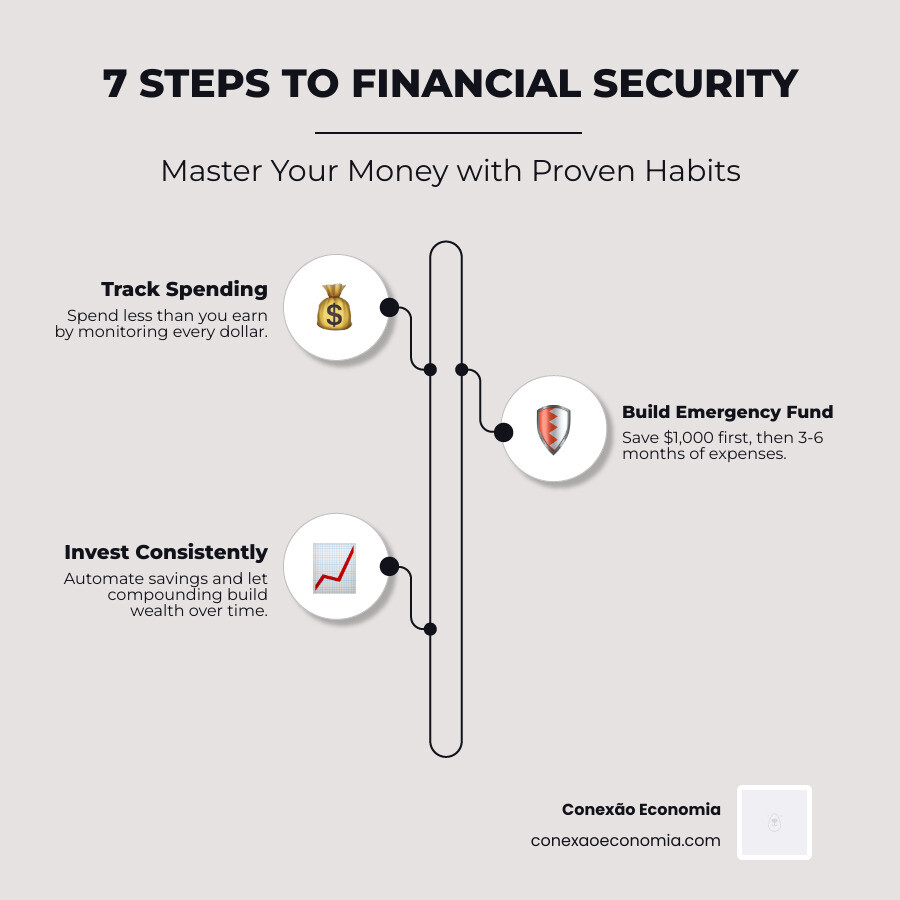
- Spend less than you earn — track every dollar in and out
- Build an emergency fund — start with $1,000, then grow to 3-6 months of expenses
- Pay off high-interest debt first — credit card rates above 17% erase any investment gains
- Automate your savings — pay yourself before you spend
- Invest early and consistently — time in the market beats timing the market
- Plan for retirement now — contributing from age 25 vs. 35 can mean a six-figure difference
- Protect what you build — insurance, a will, and tax-smart accounts round out the plan
Money stress is real. In fact, it’s one of the top sources of anxiety for most adults — and it’s easy to see why. Credit card balances in the U.S. now top $1.2 trillion, and fewer than half of Americans could cover a $1,000 emergency from savings alone.
But here’s the thing: financial security isn’t about being rich or having a finance degree. It’s about making small, consistent decisions that add up over time.
Whether you’re drowning in debt, starting from zero, or just tired of feeling like your paycheck disappears before you understand where it went — this guide is for you.
The Core Principles of Personal Finance
At Conexão Economia, we believe that wealth isn’t just a number in a bank account; it’s the freedom to live the life you want. To get there, we have to look past the spreadsheets and understand the “why” behind our money. As of April 2026, the economic landscape continues to shift, but the fundamental pillars of wealth building remain as steady as ever.
Mindset Over Math
Most people think personal finance is about being a math whiz. In reality, it is 20% head knowledge and 80% behavior. You can know every formula for interest rates, but if you can’t curb impulsive spending, the math won’t save you.
Research shows that financial stress is more than just a headache; it significantly impacts our mental health. According to the American Psychological Association, financial strain can keep us in a constant “survival mode,” making it harder to make long-term decisions. To break this cycle, we must focus on habit formation. Start by setting clear, written goals. Whether it’s buying a home or retiring by 55, having a “North Star” makes it easier to say no to temporary temptations like lifestyle inflation — the tendency to spend more just because you earn more.
The Power of Compounding
If there is one “magic” trick in finance, it’s compounding. This is when your earnings begin to earn their own earnings.

Imagine two people: one starts contributing $500 a month to a retirement account at age 25, and another starts at age 35. By the time they both reach 65, the early starter could have a difference of several hundred thousand dollars, even if they both invested the same total amount later in life. Time is your greatest asset. The longer your money stays in the market, the harder it works for you. Consistency beats intensity every single time.
Practical Advice About Personal Finance: Budgeting and Saving
Budgeting is often seen as a restrictive “diet” for your wallet, but we prefer to view it as a roadmap. It’s not about stopping yourself from spending; it’s about choosing where your money goes before you spend it.
To manage your cash flow effectively, you need a framework. Two of the most popular methods are the 50/30/20 rule and the 60/30/10+15 guideline.
| Category | 50/30/20 Rule | 60/30/10+15 Guideline |
|---|---|---|
| Needs/Essentials | 50% (Housing, Groceries, Utilities) | 60% (Max for all essential bills) |
| Wants/Lifestyle | 30% (Dining out, Hobbies) | 30% (Discretionary spending) |
| Savings/Debt | 20% (Retirement, Emergency fund) | 10% (Short-term goals/Emergency) |
| Retirement | Included in the 20% | 15% (Pre-tax retirement specific) |
At Conexão Economia, we suggest picking the one that feels most sustainable for your current income level. The goal isn’t perfection; it’s awareness.
Building Your Emergency Fund
Life happens. Cars break down, medical bills arrive, and jobs can be lost. Without an emergency fund, these events become financial disasters that land you in high-interest debt.
We recommend a two-step approach:
- The Starter Fund: Aim for $1,000 or one month of essential expenses as fast as possible. This is your “buffer” against the world.
- The Full Fund: Once your high-interest debt is gone, grow this to cover 3 to 6 months of living expenses.
Keep this money in a high-yield savings account. It should be liquid (accessible), but separate from your daily checking account so you aren’t tempted to use it for a “shoe emergency.”
Automating Your Financial Life
The easiest way to save is to make it happen without thinking. “Paying yourself first” means setting up an automatic transfer on payday. If the money moves to your savings or retirement account before you even see it in your checking balance, you’ll learn to live on what’s left. This turns saving into a default habit rather than a monthly struggle of willpower.
Strategies to Eliminate Debt and Start Investing
Debt is the biggest anchor holding people back from building wealth. With average credit card interest rates pushing 17% (and many cards exceeding 25%), carrying a balance is a guaranteed way to lose money.

Debt Avalanche vs. Debt Snowball
When it comes to advice about personal finance regarding debt, there are two main schools of thought. Both require you to pay the minimum on all debts while putting every extra dollar toward one specific target.
- The Debt Avalanche: You target the debt with the highest interest rate first. Mathematically, this saves you the most money in interest and gets you out of debt faster.
- The Debt Snowball: You target the debt with the smallest balance first. While you might pay slightly more in interest over time, the psychological win of crossing a debt off your list quickly provides the momentum many people need to stay the course. Research suggests that the “small wins” of the snowball method are often more effective for long-term success because they reinforce positive behavior.
Beginner-Friendly Advice About Personal Finance Investing
Once your high-interest debt (anything over 6-7%) is gone, it’s time to put your money to work. For beginners, the stock market can feel like a casino, but it doesn’t have to be.
A classic rule of thumb is the 110-age rule: Subtract your age from 110. The resulting number is the percentage of your portfolio that should be in stocks (equities), with the remainder in bonds (fixed income). For example, a 30-year-old would have 80% in stocks and 20% in bonds.
Instead of trying to pick the “next big stock,” consider low-cost index funds or target-date funds. These allow you to own a tiny piece of hundreds of companies, providing instant diversification and reducing your risk.
Leveraging Employer Matches
If your employer offers a 401(k) or 403(b) match, that is a 100% return on your money instantly. It is literally “free money.” Always contribute at least enough to get the full match before investing anywhere else. Failing to do so is like leaving part of your salary on the table every month.
Protecting Your Future: Retirement and Estate Planning
As we look toward the future in 2026, retirement planning is more critical than ever. Social Security is a helpful supplement, but it was never intended to be a full retirement plan.
To stay on track, use these salary benchmarks:
- By age 35: Have 2x your annual salary saved.
- By age 50: Have 6x your annual salary saved.
- By late 60s: Aim for 10x your annual salary.
If you are behind, don’t panic. Increase your contributions by just 1% each year. You’ll hardly notice the difference in your paycheck, but your future self will thank you. For more on our philosophy of long-term planning, visit our Sobre Nosotros page.
Advanced Advice About Personal Finance: Insurance and Wills
Wealth building isn’t just about offense (investing); it’s also about defense. One major illness or lawsuit can wipe out years of hard work.
- Health Insurance: Ensure you have adequate coverage to avoid catastrophic medical debt.
- Life Insurance: If anyone depends on your income, term life insurance is a must.
- Disability Insurance: Your ability to earn an income is your most valuable asset. Protect it.
- Wills and Estate Planning: You don’t need to be a millionaire to need a will. An estate plan ensures your assets go to the right people and that your medical wishes are respected through directives and power of attorney.
Tax Optimization and HSAs
Understanding taxes is a key part of advice about personal finance. In 2026, the contribution limits for 401(k)s have risen to $24,500, and IRAs to $7,500.
One of the most powerful tools available is the Health Savings Account (HSA). It offers a “triple-tax advantage”:
- Contributions are tax-deductible (lowering your taxable income).
- Growth is tax-free.
- Withdrawals for qualified medical expenses are tax-free.
Unlike an FSA (Flexible Spending Account), HSA funds do not expire at the end of the year. You can invest this money and let it grow for decades, essentially creating a second retirement account for healthcare costs.
Frequently Asked Questions about Money Management
How should I prioritize these financial tips?
The best way to start is by getting “organized.” First, track your spending for 30 days. Second, build a $1,000 “starter” emergency fund. Third, look at your debt. If you have credit card debt, focus all your energy there while only contributing enough to your retirement to get an employer match. Once the high-interest debt is gone, finish your 3-6 month emergency fund, then move on to aggressive investing (aiming for 15% of your income).
What are common mistakes to avoid?
One of the biggest wealth-killers is buying new cars. A new vehicle can lose 40-50% of its value in the first few years. Buy used and drive it for a decade. Another mistake is cashing out retirement accounts when you change jobs; this triggers massive taxes and penalties while stealing from your future. Lastly, don’t prioritize your children’s college fund over your own retirement. Your kids can get loans for school; you cannot get a loan for retirement.
Do personal finance best practices vary by income level?
Surprisingly, no. Whether you make $40,000 or $400,000, the fundamentals are identical: spend less than you make, avoid “bad” debt, and invest for the future. The only thing that changes is the scale of the numbers and the speed at which you reach your goals. The habits of a person who saves $100 a month are exactly the same habits required to save $10,000 a month.
Conclusion
Mastering your money doesn’t happen overnight. It is a lifetime journey of education and sustainable habits. By focusing on the principles we’ve discussed — from the 50/30/20 rule to the power of compounding — you are taking control of your future.
At Conexão Economia, we are dedicated to providing you with the practical financial literacy you need to make smarter decisions every day. The best time to start was ten years ago; the second best time is today. Take that first step, automate that first transfer, and start building the freedom you deserve.
