
Modern Portfolio Theory: Your Ticket to Nobel Level Returns
The Investment Strategy That Changed Finance Forever
The Nobel prize portfolio strategy — rooted in Harry Markowitz’s Modern Portfolio Theory (MPT) — is one of the most influential frameworks in investing history. In short, it argues that how you combine assets matters more than which assets you pick.
Here’s the core idea at a glance:
| Principle | What It Means for You |
|---|---|
| Diversification | Spread investments to reduce risk without sacrificing returns |
| Correlation | Mix assets that don’t move together to smooth out volatility |
| Efficient Frontier | Find the portfolio with the best return for your risk level |
| Risk vs. Return | Every investment decision involves a trade-off — MPT helps you optimize it |
Markowitz first published this idea in the Journal of Finance in 1952. It was so groundbreaking that he was awarded the Nobel Prize in Economic Sciences in 1990 — nearly four decades later.
But here’s where it gets interesting.
When asked how he personally invested his own money, Markowitz didn’t pull out a covariance matrix. He simply split his portfolio 50/50 between stocks and bonds — to minimize future regret, not to maximize mathematical efficiency.
That tension between theory and practice is exactly what makes this topic so worth understanding.
Whether you’re managing your first investment account or trying to make sense of what your financial advisor is actually doing with your money, MPT gives you a powerful mental model for thinking about risk, return, and diversification.

The Birth of the Nobel Prize Portfolio Strategy
Before Harry Markowitz arrived on the scene in the early 1950s, investing was largely an exercise in “stock picking.” Investors looked for the “best” company, bought its stock, and hoped for the best. If you wanted to be safe, you bought “safe” securities. There was no mathematical framework to explain how different investments worked together.
Markowitz changed everything by shifting the focus from individual stocks to the portfolio as a whole. He realized that risk isn’t just about how much one stock bounces around; it’s about how all your stocks bounce together. This insight led to what many call the “only free lunch in finance”: diversification.
The investment strategy of the Nobel Foundation itself provides a perfect historical lesson. In its early years, the Foundation followed Alfred Nobel’s will strictly, investing only in “safe securities” like bonds and loans. By 1953, high taxes and inflation had shrunk the fund’s value to just $3 million. It wasn’t until they embraced modern, diversified strategies—including equities and real estate—that the fund recovered, eventually growing to over SEK 6 billion by 2021.
Who is Harry Markowitz?
Harry Markowitz was a brilliant American economist who began his journey at the University of Chicago. His path wasn’t always smooth; during his PhD defense, the legendary Milton Friedman famously joked that Markowitz’s work “wasn’t economics,” because it was so heavily focused on mathematics and probability.
Fortunately, the committee disagreed, and Markowitz went on to work at the RAND Corporation and later co-founded firms like CACI and GuidedChoice. His “a-ha” moment happened in a library while reading about the probability of returns. He realized that if an investor only cares about expected returns, they would put all their money into the single best asset. Since people don’t do that, they must be trying to minimize risk—and that risk could only be measured by looking at the correlations between assets.
Why MPT Won the Nobel Prize
Markowitz shared the 1990 Nobel Prize in Economic Sciences for creating the “mean-variance” framework. This was the first time anyone had provided a rigorous mathematical way to balance the “mean” (expected return) against the “variance” (risk).
This shift from micro-analyzing a single company to constructing a holistic portfolio revolutionized Wall Street. It allowed institutional investors to move away from guesswork and toward scientific asset allocation. Today, even the Official Nobel Foundation Investment Guidelines reflect these principles, emphasizing ESG integration and a diversified mix of global assets to ensure the prizes can be funded for centuries to come.
How the Nobel Prize Portfolio Strategy Works Mathematically
We promise to keep the math “warm and friendly,” but to understand the Nobel prize portfolio strategy, we have to look at the engine under the hood. MPT relies on four main pillars:
- Expected Return: The weighted average of the possible returns of the assets in the portfolio.
- Variance: A measure of how much an asset’s return fluctuates around its average.
- Covariance: This measures how two assets move in relation to each other.
- Correlation: A simplified version of covariance (ranging from -1 to +1).
The magic happens when you combine assets that have a low correlation. If Stock A goes up when the sun shines and Stock B goes up when it rains, a portfolio of both will be much steadier than owning just one.
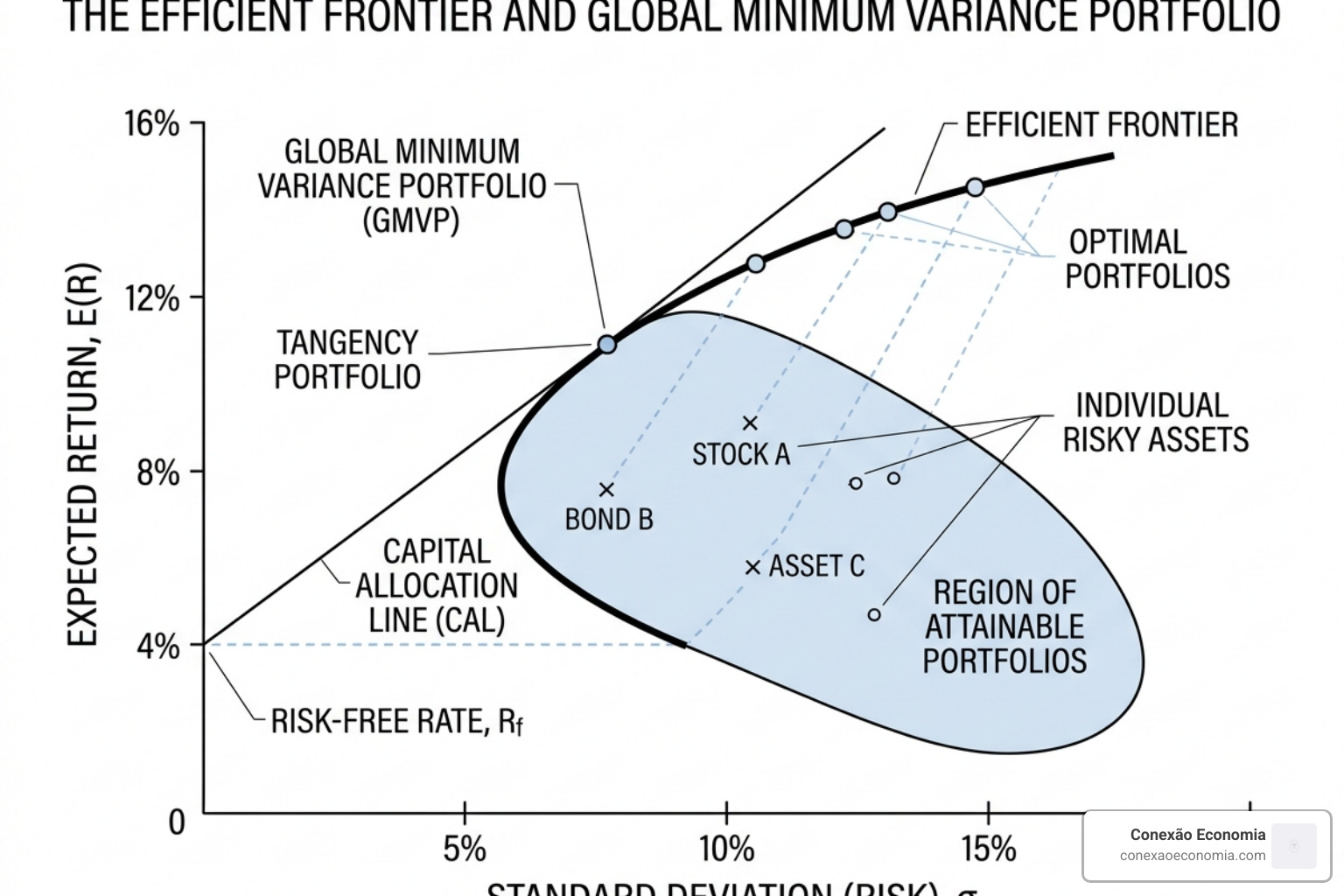
Understanding Covariance and Correlation
The goal of MPT is to reduce “idiosyncratic risk”—the risk specific to one company (like a CEO scandal or a factory fire). By diversifying across many assets, these individual shocks cancel each other out.
However, MPT cannot protect you from “systemic risk”—events like a global pandemic or a financial meltdown that affect everyone at once. This is a crucial distinction. As we saw in early 2020, when the world stops, almost all correlations go to 1.0 (meaning everything drops together).
The Two Mutual Fund Theorem
If the math feels overwhelming, the “Two Mutual Fund Theorem” (or Separation Theorem) is your best friend. It suggests that any investor, regardless of their risk tolerance, can achieve an optimal portfolio by holding just two things:
- A “risk-free” asset (like US Treasury bills).
- The “tangency portfolio” (the single best mix of risky assets on the efficient frontier).
By changing the ratio between these two, you can create a customized risk level without needing a PhD in mathematics.
The Efficient Frontier: Mapping Your Path to Optimal Returns
The “Efficient Frontier” is the holy grail of the Nobel prize portfolio strategy. It is a curved line on a graph that represents the set of portfolios offering the highest expected return for a specific level of risk.
Anything below the curve is “suboptimal” because you could get more return for the same risk, or the same return for less risk.
| Portfolio Type | Typical Asset Mix | Goal |
|---|---|---|
| Conservative | 20% Equities / 80% Bonds | Capital preservation; low volatility |
| Moderate | 50% Equities / 50% Bonds | Balanced growth; the “Markowitz Personal” |
| Aggressive | 80% Equities / 20% Alternatives | High growth; accepts large swings |
To understand where the Nobel Prize money comes from, look no further than this frontier. The Foundation targets a return of at least 3% above inflation. To hit that, they can’t just sit in “safe” cash; they must move along the frontier into equities and alternative assets.
Constructing the Frontier in 2026
In April 2026, we have tools Alfred Nobel never dreamed of. Robo-advisors and advanced software can calculate these frontiers in milliseconds. However, the inputs—historical data—remain the biggest challenge. Just because tech stocks had a 0.5 correlation with bonds in the past doesn’t mean they will in the future.
Beyond Markowitz: CAPM and Black-Litterman
While Markowitz built the foundation, others added the skyscraper. William Sharpe introduced the Capital Asset Pricing Model (CAPM), which gave us “Beta”—a way to measure an asset’s sensitivity to the overall market. Later, the Black-Litterman model allowed investors to combine MPT math with their own subjective “views” on the market, making the theory more flexible for real-world use.
Why the Creator of MPT Chose a Simple 50/50 Strategy
Here is the ultimate irony: the man who won a Nobel Prize for complex mathematical optimization didn’t use it for his own retirement account.
Harry Markowitz famously told Jason Zweig that in the 1950s, he didn’t have the computing power to solve his own equations. But even later in life, he stuck to a simple 50/50 split between stocks and bonds.

The Irony of Complexity
Why would a genius ignore his own genius? Because of regret minimization. Markowitz realized that if the market went up and he wasn’t in it, he’d regret it. If it went down and he was all-in, he’d also regret it. By being 50/50, he ensured that no matter what happened, he would only be “half wrong.”
Why Simplicity Often Beats Complex Nobel Prize Portfolio Strategy
Research by Levy and Markowitz showed that a simple mean-variance approximation actually correlates with “true” utility functions at a level of 0.99 for most diversified portfolios. In plain English: the complex math and the “good enough” simple strategy often end up in the same place.
Complexity often introduces “estimation error.” If you put garbage data into a complex model, you get “optimized garbage” out. Simplicity, on the other hand, is robust. It’s harder to mess up a 50/50 split than it is to mess up a 40-asset covariance matrix.
Shortcomings and Real-World Challenges to MPT
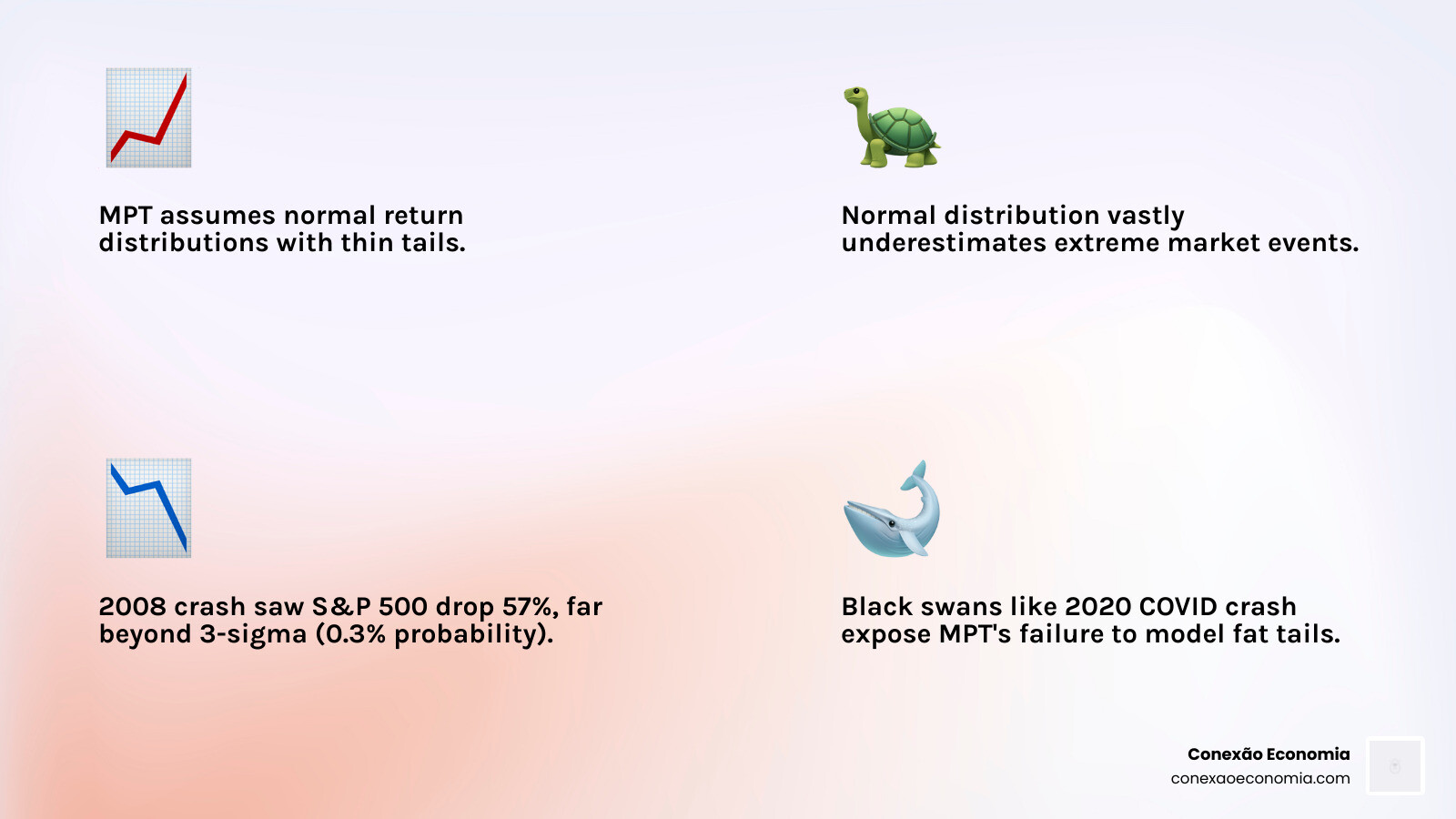
While we love MPT at Conexão Economia, we also have to be honest about where it fails. The biggest flaw is its reliance on historical data. MPT assumes the future will look like the past, but the market is famous for “Black Swan” events—unpredictable shocks like the 2008 crash or the 2020 pandemic.
Empirical Evidence Against MPT
Several famous studies have challenged the idea that the “market” is perfectly efficient or that MPT is the only way to win:
- The Small Firm Effect: Rolf Banz showed that small-cap stocks tend to outperform large-cap stocks more than their “risk” would suggest.
- Low P/E Outperformance: Sanjay Basu found that stocks with low price-to-earnings ratios often beat the market, contradicting the idea that you can only get higher returns by taking more MPT-defined risk.
Behavioral Biases and Market Reality
MPT assumes we are all “rational actors” who make decisions based on cold logic. In reality, humans are emotional. We buy when things are expensive (greed) and sell when they are cheap (fear). This herd behavior creates market bubbles and crashes that MPT’s “normal distribution” curves simply can’t predict.
Practical Steps to Implement a Nobel Prize Portfolio Strategy
You don’t need to be a math whiz to use a Nobel prize portfolio strategy. You just need to be disciplined. Here is how we suggest building your own “Nobel-style” portfolio:
Building Your Diversified Core
The Nobel Foundation’s current target allocation is a great blueprint for long-term investors:
- 55% Equities: Global stocks for growth.
- 10% Fixed Income: Bonds for stability.
- 10% Real Estate/Property: For inflation protection.
- 25% Alternative Assets: Hedge funds or private equity (for those with higher capital).
For most of us, this can be replicated using low-cost ETFs. You can buy a “Total World Stock” ETF, a “Total Bond Market” ETF, and a REIT ETF to cover 75% of this strategy in three simple trades.
Rebalancing and Maintenance
The key to MPT isn’t just setting it; it’s resetting it. If your stocks do great and your bonds do poorly, your 50/50 split might become 70/30. This means you are now taking more risk than you intended. Rebalancing annually—selling a bit of what went up to buy what went down—is the secret sauce that forces you to “buy low and sell high.”
Frequently Asked Questions about Nobel Prize Portfolio Strategy
Can an individual investor realistically build an efficient frontier?
Yes! While you might not calculate the exact math yourself, using a diversified mix of index funds essentially puts you on the frontier. Most modern investment platforms provide “risk-tolerance” portfolios that are pre-built using MPT principles.
How does the Nobel Foundation currently invest its funds?
As of our 2026 data, the Foundation uses a “Responsible Investment” framework. They follow the UN Global Compact, meaning they avoid producers of controversial weapons, tobacco, and companies that get more than 5% of their revenue from coal. They prove that you can be “Nobel-level” profitable while being ethically responsible.
Is the 50/50 strategy better than mathematical MPT for retail investors?
For many, yes. The “best” portfolio is the one you can stick with during a market crash. If a complex mathematical model makes you nervous, you’ll sell at the bottom. If a simple 50/50 or 60/40 split gives you peace of mind, it will likely perform better in the long run because you’ll stay invested.
Conclusion
The Nobel prize portfolio strategy taught us that we don’t have to be “lucky” stock pickers to build wealth. By understanding the relationship between risk and return, and by embracing the power of diversification, we can build portfolios that stand the test of time—just like the Nobel Prizes themselves.
At Conexão Economia, we believe that financial literacy is the ultimate “free lunch.” Whether you choose a complex optimized model or a simple 50/50 split, the most important step is to start. Start making smarter financial decisions today and put the power of Nobel-winning science to work for your future.
